








Contact info

Follow us

Search Blog, projects, Service or people.

Manufacturing Execution System

MES Solution

Manufacturing Execution System (MES) for Real-Time Production Monitoring and Shop Floor Control

A manufacturing execution system connects shop floor activity with production records. Plant teams can review output, downtime and quality information while production is underway.

Machine status, work order progress, downtime reasons, quality results — Micraft MES closes that gap. Deploy in 30–60 days without disrupting your current operations.

Explore Micraft MES, manufacturing operations and the Tata manufacturing case study for related workflows and implementation context.
The Operational Gap

Your ERP Tells You What to Make. It Cannot Tell You What Is Actually Happening.

The "Blind Spot"

Without a live execution layer, your production data is always reactive — arriving in reports long after the shift has ended.

  • Decisions made on yesterday's reports
  • Downtime reasons reconstructed from memory
  • Bottlenecks discovered too late to fix

Micraft MES Clarity

Micraft MES closes the gap, capturing live data at the source and turning it into a real-time operational dashboard.

  • Live visibility of every line and machine
  • Automated OEE and downtime capture
  • Proactive adjustments based on NOW

What is a Manufacturing Execution System?

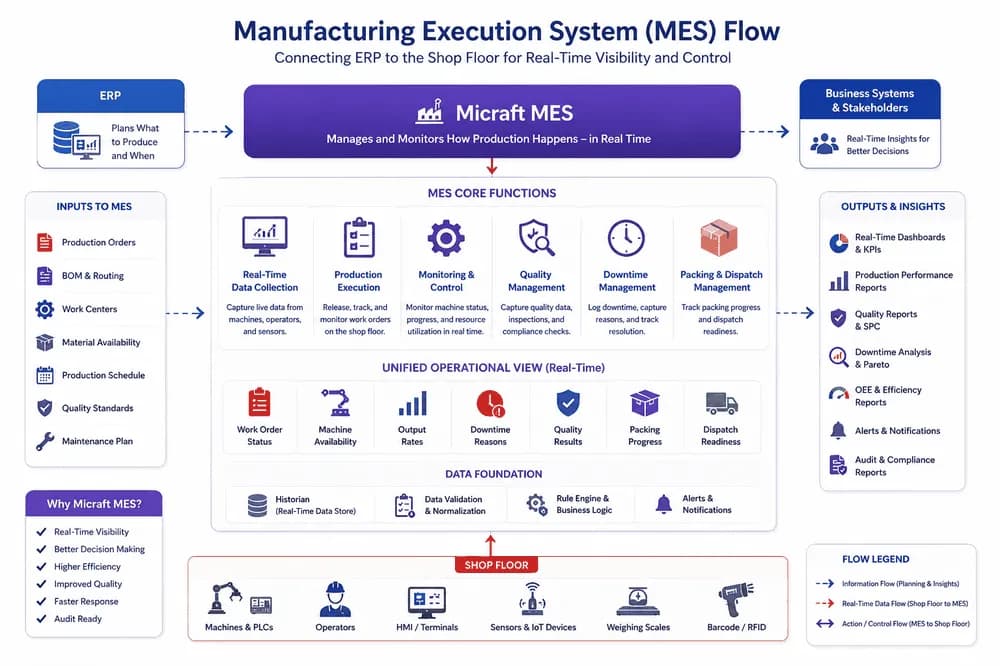
A Manufacturing Execution System sits between your ERP and your shop floor. Your ERP plans what to produce and when. MES manages and monitors how that production actually happens — in real time, from the floor up.

Micraft MES captures live data from machines, operators, and production processes and turns it into a unified operational view — work order status, machine availability, output rates, downtime reasons, quality results, packing progress, and dispatch readiness — all current, all in one place.

The result is a production environment where managers act on what is happening now, not on what was reported an hour ago.

MES Flow Diagram

What Micraft MES Does

Real-Time Production Tracking

Live visibility of every work order on every machine across every line — output, cycle times, progress against target, and completion status. Not a morning report. Not an end-of-shift summary.

OEE Monitoring

Availability, Performance, Quality Overall Equipment Effectiveness measured continuously for every asset. Losses are identified as they occur.

Machine Downtime Capture

Downtime reasons recorded directly from the shop floor — by the operator, at the machine, at the moment the stoppage happens.

Work Order Management

Production orders received from your ERP, broken down into executable tasks, assigned to machines and operators.

Quality Inspection

Quality checks built into the production workflow — inline, at defined checkpoints. Defects recorded at the point they occur.

Dispatch Readiness

Visibility extends past production into packing and dispatch — what is packed, what is staged, what is ready to ship.

// Intelligence Layer

AI-Powered Production Intelligence

Advanced modules that go beyond monitoring into prediction and autonomous optimisation.

Predictive Maintenance

Identifies patterns that precede equipment failure before the failure happens using vibration and heat analysis. Reduces unplanned downtime by up to 40%.

Predictive Quality

Flags conditions that historically precede quality defects at the source, reducing scrap and rework across the production line.

Scheduling Optimisation

Adjusts production schedules dynamically as conditions on the floor change, ensuring maximum line utilization and on-time delivery.

Machine Vision Inspection

Automated visual quality checks at speed and scale using high-speed cameras and neural networks to detect defects invisible to the human eye.

Digital Twin Simulations

Model production scenarios and 'what-if' cases in a digital environment before implementing changes, reducing risk and testing costs.

Multi-Plant and Multi-Site Visibility: All plants, all lines, all locations managed from one platform. Performance compared across sites. Best practices identified from data.

Shop Floor Data Collection: Data captured through operator terminals, tablets, barcode scanners, or direct IoT connectivity — depending on your floor setup.

Operational Impact

What Changes After Micraft MES Goes Live

These are outcomes from Micraft MES implementations — not marketing benchmarks:

20-40%

Downtime Reduction

Reduction in unplanned downtime through real-time capture and predictive analysis. Capture the 'why' at the moment it happens.

25-30%

Efficiency Gain

Improvement in Overall Equipment Effectiveness (OEE) and line utilization through immediate bottleneck visibility.

100%

Traceability

Full digital record of every part, every operator, and every production step. Complete compliance for regulated industries.

6-12m

Proven ROI

Rapid deployment and immediate operational gains lead to complete return on investment within 6 to 12 months of go-live.

The Micraft Methodology

Rapid Go-Live: From Audit to Insight in 60 Days

Micraft MES is designed for manufacturers who need results now. We don't spend 18 months planning; we spend 8 weeks delivering.

01

Site Audit & Process Mapping

Weeks 1-2

We audit your existing machine landscape, data points, and manual reporting gaps. No disruption to production.

02

Configuration & IoT Integration

Weeks 3-6

The platform is configured to your floor layout. IoT bridges and operator terminals are installed and verified.

03

Go-Live & Shop Floor Training

Weeks 7-8

Your team is trained on the floor. Live data flows into dashboards, and the system is fully operational.

Built for Manufacturers Who Need Real Visibility

  • Discrete manufacturers — automotive, engineering, electronics — tracking units and production stages with precision.
  • Process manufacturers — pharmaceuticals, food & bev — managing batches, recipes, and compliance.
  • Manufacturing SMEs — ready to move beyond manual reports and Excel-based tracking to operational intelligence.
  • Multi-plant organisations — that need consistent visibility and performance data across all sites.

Micraft MES vs Manual Operations

Manual Operations
Micraft MES
End-of-shift reports (Reactive)
Production Data
Live as it happens (Proactive)
Discovered after fact / Guessed
Downtime Tracking
Captured at source automatically
Estimated weekly on spreadsheets
OEE Measurement
Continuous, real-time OEE visibility
End-of-line inspections only
Quality Control
Inline checkpoints & automated vision
Manual registers & Paper trails
Traceability
Complete 100% digital genealogy
12–18 months (Traditional)
Deployment
30–60 days (Rapid Go-Live)
Connected Ecosystem

Connects to Your Plant's Data Architecture

Micraft MES isn't an island. It integrates with your existing tech stack to ensure data flows seamlessly from production to finance.

Micraft MES Hub

The central execution engine that captures floor data and synchronizes it across all enterprise systems.

Live API Synchronization
Bi-directional Data Flow

ERP Systems

SAP, Oracle, Dynamics

Micraft WMS

Inventory Sync

DoxCraft

Digital SOPs

IoT Sensors

Machine Data

Practical MES Built for Results

Enterprise MES platforms — SAP ME, Siemens Opcenter, Rockwell FactoryTalk — are powerful. They are also expensive, complex, and built for large enterprises with dedicated IT teams.

Micraft MES is built for the manufacturer who knows they need execution visibility and knows they cannot spend 18 months getting there.

The system is configurable to your floor setup without requiring a software engineering team. Operator interfaces are intuitive, and training time is minimal.

Backed by three-level support — L1, L2, L3 — with defined SLAs and 24/7 availability for critical production issues.

General Questions

ERP manages business operations — orders, inventory planning, finance, procurement. MES manages execution — what is actually happening on the production floor right now. Your ERP tells the plant what to make and when. Micraft MES tracks and controls how it gets made — machine by machine, work order by work order, in real time. Both are necessary. They solve different problems.

Initial deployment is completed in 30–60 days for most implementations. Phased rollouts are available for larger environments. This is significantly faster than traditional enterprise MES platforms, which typically require 12–18 months. Micraft MES is designed to deliver value within weeks of go-live, not after a multi-year stabilisation period.

Yes. Micraft MES supports discrete manufacturing — tracking individual units, assemblies, and production stages — and process manufacturing — managing batch production, recipes, and compliance documentation. Industry-specific configurations are available for automotive, electronics, pharma, and general manufacturing.

Yes. Micraft MES supports multi-plant operations with centralised or distributed control. You can monitor, compare, and manage production performance across all sites from a single dashboard.

Micraft MES includes Predictive Maintenance, Predictive Quality, Real-Time Scheduling Optimisation, Machine Vision Inspection, and Digital Twin Simulations. These are built into the platform — not separate modules requiring additional integration.

Both, and hybrid. Cloud deployment offers scalability and remote access. On-premise ensures data residency and local control. Hybrid allows critical real-time functions to remain on-site with cloud-based analytics. The deployment model is chosen based on your infrastructure and IT requirements.

Through operator terminals, tablets, barcode scanners, or direct IoT and machine interface connections — depending on your environment. The system is designed to work with your existing hardware where possible, minimising the infrastructure investment required at go-live.

Ready to See What is Actually Happening on Your Shop Floor — Right Now?

If your production decisions are being made on shift reports from this morning, OEE numbers from last week, and downtime records nobody fully trusts — Micraft MES fixes that. And it does it in 30–60 days, not 18 months.