






Contact info

Follow us

Search Blog, projects, Service or people.

Multi-Courier Optimization

Multi Courier Shipping Optimization

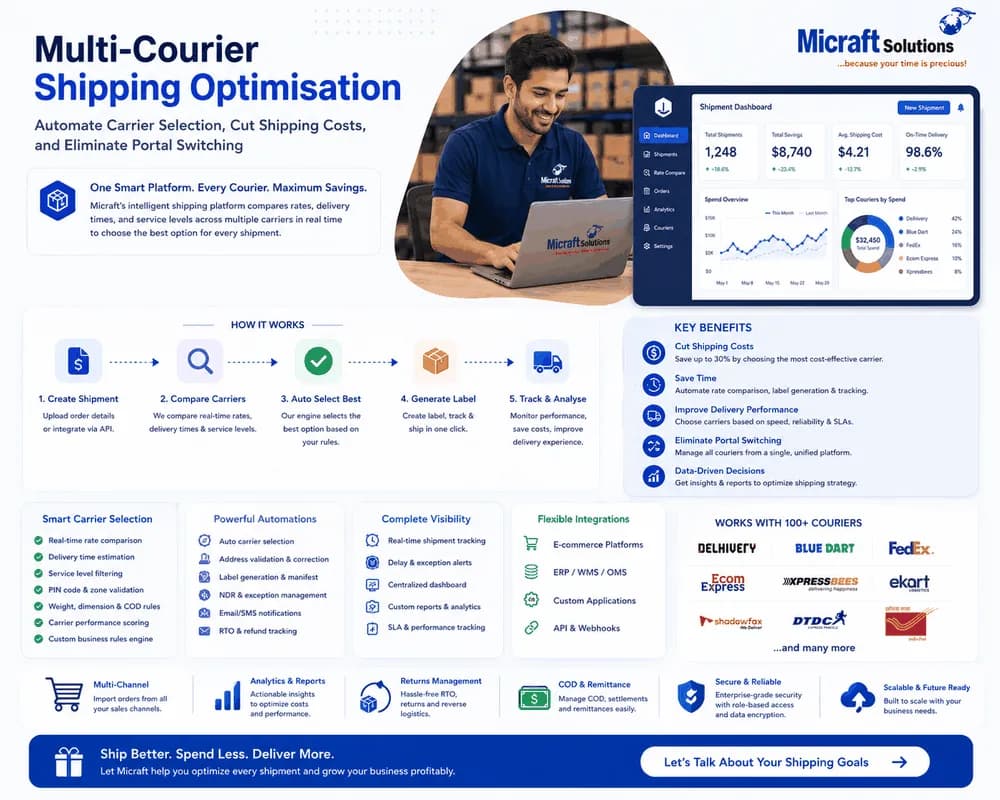
Multi-Courier Shipping & Freight Automation — Automate Carrier Selection, Cut Shipping Costs, and Eliminate Portal Switching

Businesses using three or more courier partners simultaneously are managing a complexity that manual processes cannot handle at scale.

This use case describes how Micraft Courier Aggregator replaces the daily manual coordination of multiple courier portals with a single automated platform — delivering lower shipping cost per order, consistent carrier performance, and unified visibility across every shipment.

The Operational Problem

Affects Every Business Shipping at Scale

Any business that uses more than one courier partner faces a version of the same problem — and the severity scales directly with daily shipment volume. The core problem is identical: the information required to select the best carrier is available (live rates, historical performance, pin code serviceability), but the manual process of applying that information at the transaction level is not scalable.

D2C & E-Commerce

Using Delhivery for metro, Bluedart for express, and Shadowfax for same-day means logging into four portals, comparing rates manually, and tracking across separate dashboards.

Manufacturers & Distributors

Shipping finished goods to B2B customers across India with different carrier performance profiles by region requires carrier selection decisions at the individual shipment level.

3PL Providers

Managing shipping operations for multiple clients, each with different carrier preferences, SLA requirements, and cost structures — needing to apply different rules per client.

Marketplace Sellers

Delivery performance directly affects seller ratings. Needing the right carrier for each order based on destination and priority rather than defaulting to a single carrier.

Without an Aggregator

The Daily Operational Reality of Manual Management

Carrier selection defaults to familiarity

The dispatcher selects the carrier they are most comfortable with, not the optimal one for the destination and weight. At 500 shipments a day, this is a measurable financial loss.

Rate comparison is skipped

Checking live rates across four portals before every shipment is not realistic. Static assumptions miss the rate variations that occur by day and by pin code cluster.

Tracking requires four browser tabs

Customer service queries require opening the right portal, finding the shipment, and reading the status. There is no single view of what is happening across the portfolio.

COD reconciliation is manual

Matching remittances requires downloading files from each portal and reconciling shipment-by-shipment. Discrepancies surface weeks after they occurred.

Peak volume breaks the process

A volume surge exposes the fragility of manual management. The process slows down, creating delayed dispatch, or carrier selection degrades in quality.

The Mechanisms

How Micraft Solves Multi-Courier Complexity

Single API Connection Replaces Multiple Logins

The Aggregator manages all communication with each carrier's API. A new carrier partner is added as a configuration change — not a development project. The operational team never logs into a carrier portal again.

Live Rate Comparison Before Every Shipment

Fetches live rates from all integrated carriers and evaluates them against weight, dimensions, pin code, and payment type. The carrier selected is genuinely best for that shipment. Compounded over thousands of shipments, this generates massive savings.

Rule-Based Intelligent Selection

Apply business rules: Metro destinations → best SLA carrier. Remote pin code → highest success rate carrier. COD order → strongest remittance track record. Rules defined once, applied automatically.

Automated Booking & Label Generation

Once selected, the Aggregator books the shipment, generates the AWB, and produces the label without manual steps. During a peak sale of 5,000 orders, the system processes them with zero additional headcount.

Unified Tracking Dashboard

Every shipment from every carrier visible in a single dashboard updated in real-time. Exception management proactively flags delayed shipments and SLA breaches before customer complaints arrive.

Automated COD Reconciliation

When carrier remittances arrive, the Aggregator matches them against expected amounts automatically — identifying shortfalls and surpluses in real time.

Real World Applications

How Different Businesses Apply This

D2C Brand Managing Festive Peak

Processes 8,000 orders in 36 hours. Before: hired extra staff for manual booking. After: same team processes peak volume automatically. Carrier selection is systematic (express orders routed fastest, standard to most cost-effective).

Manufacturer Reducing B2B Costs

Ships 1,200 orders to dealers monthly. Aggregator introduces live rate comparison: identifies a secondary carrier that is 15-22% cheaper for large pin code clusters. Monthly shipping cost reduction measurable instantly.

3PL Managing Multi-Client Rules

Manages logistics for six clients with different carrier preferences. After Aggregator: client-specific carrier rules are configured in the system. No dispatcher involvement in carrier selection, eliminating rule application errors.

Reducing Tier 2/3 RTO Rates

High RTO in non-metros. Aggregator data reveals one carrier has significantly higher success rates in those specific pin codes. Rules updated to route those orders to the higher-performing carrier, directly reducing COD write-offs.

Proven Results

Measured Outcomes

Reduced

Shipping Cost Per Order

Through systematic live rate comparison applied to every shipment rather than periodic rate card reviews.

Slashed

Order Processing Time

When booking and label generation are automated rather than executed manually per order.

Improved

Delivery Success Rate

Through performance-based carrier selection that routes away from underperforming carriers in specific geographies.

Automated

COD Reconciliation

Reduced from a multi-day monthly exercise to a continuous process with real-time discrepancy flagging.

Deployment

Technical Implementation

1

Integration Points

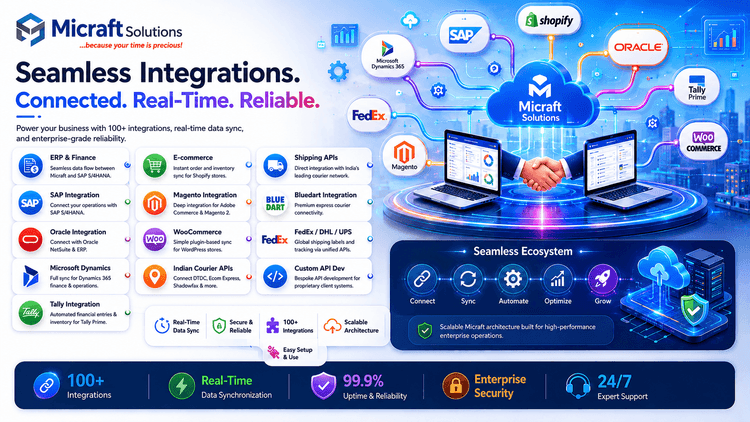
Integrates with your ERP, WMS, or e-commerce platform (Shopify, WooCommerce, Magento) for automatic order ingestion — and accounting systems (Tally, Zoho Books) for COD data.

2

Carrier Network

Delhivery, Bluedart, DTDC, Ecom Express, Shadowfax, Xpressbees, Ekart, FedEx, DHL — and an expanding network. New carriers added via configuration, not code.

3

Timeline

Cloud-based SaaS platform. Implementation including carrier connectivity and rule configuration typically completed within 2 to 4 weeks.

Stop Guessing Which Courier Is Best.

Automate your carrier selection, unify your tracking, and instantly reconcile COD across every shipping partner from a single platform.