



Almost every manufacturing IT department asks the same question when the Quality team requests a new Document Management System (DMS): "We already pay for Microsoft 365. Why can't we just use SharePoint?"
It is a fair question. SharePoint is a powerful, ubiquitous platform. However, managing marketing brochures in SharePoint is fundamentally different from managing standard operating procedures (SOPs) on a factory floor.
Here is an honest breakdown of where SharePoint works, where it breaks down for manufacturers, and why dedicated systems like DoxCraft exist.
Where SharePoint Shines
SharePoint is arguably the best collaborative workspace in the world. If a team of five engineers needs to co-author a new product specification, track changes in real-time, leave comments for each other, and securely share it with an external vendor, SharePoint (and Teams) is unmatched.
It is built for creation and collaboration.
Where SharePoint Fails in Manufacturing
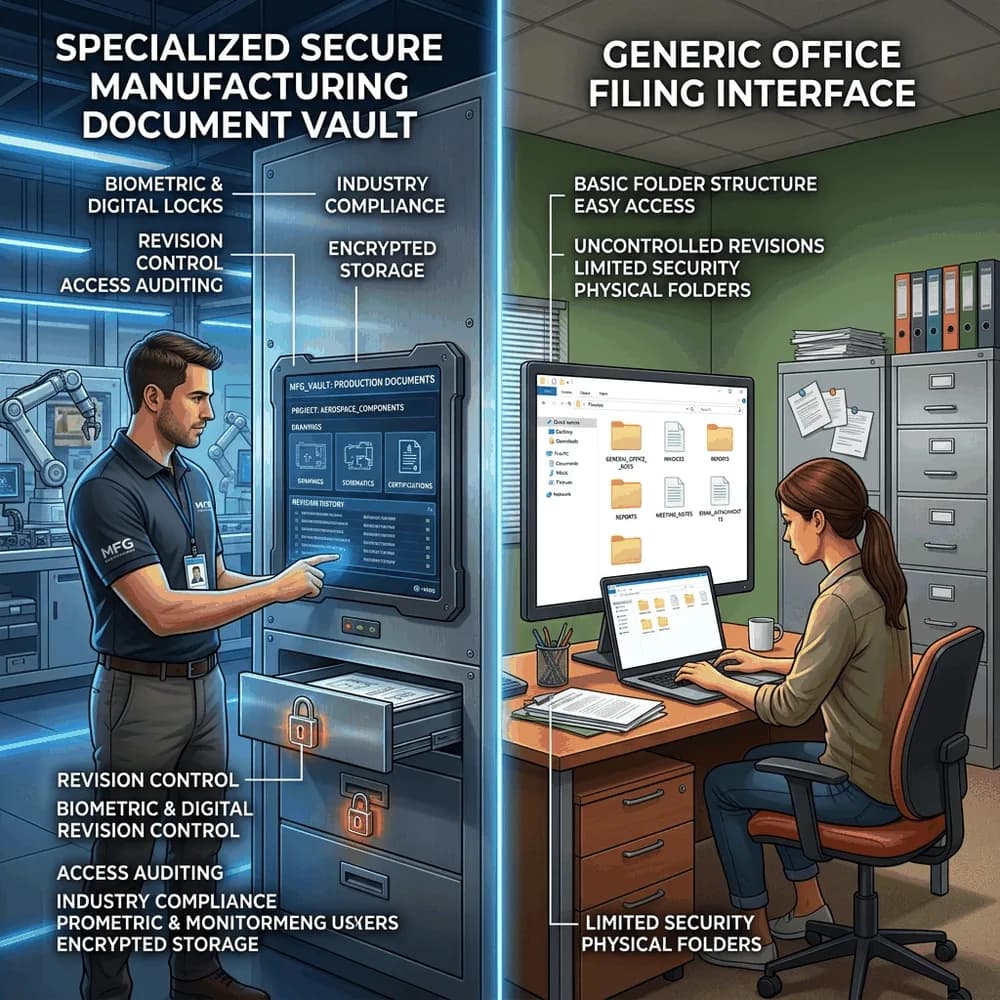
The problem arises when that product specification is finalized and needs to be strictly controlled on the shop floor. Manufacturing Quality requires control and compliance, which actively conflicts with SharePoint's open collaboration model.
- Uncontrolled Printing and Viewing: In a factory, if a worker builds a part using Revision A of an SOP when Revision B was released yesterday, the part is scrap. SharePoint makes it very difficult to prevent users from downloading, saving locally, or printing documents. DoxCraft utilizes specialized viewers that prevent downloading and printing, ensuring operators only ever see the live, current revision on their terminal.
- Training Matrix Integration: Releasing a new SOP is only half the battle; ensuring operators actually read it is the other half. SharePoint has no native concept of training. When a document is updated in DoxCraft, it automatically invalidates the training status of relevant employees and forces them to complete a read-and-understand acknowledgment before they can log into their machine.
- FDA and ISO Audit Trails: While SharePoint has version history, it is not built for regulatory scrutiny. DoxCraft enforces rigid workflows: Draft → Review → Approval (with multi-factor electronic signatures) → Effective Date scheduling. The audit trails are tamper-proof by design, specifically formatted to satisfy ISO 9001 or FDA inspectors.
The Verdict
If your goal is an intranet where HR can post the holiday schedule and engineers can collaborate on drafts, use SharePoint. Do not buy a dedicated DMS for that.
But if you are managing SOPs, work instructions, and quality policies where using an outdated version could result in a product recall or a failed ISO audit, you need a system built specifically for document control. Attempting to customize SharePoint with third-party add-ons to achieve this level of control usually results in a slow, expensive system that still frustrates the Quality team.