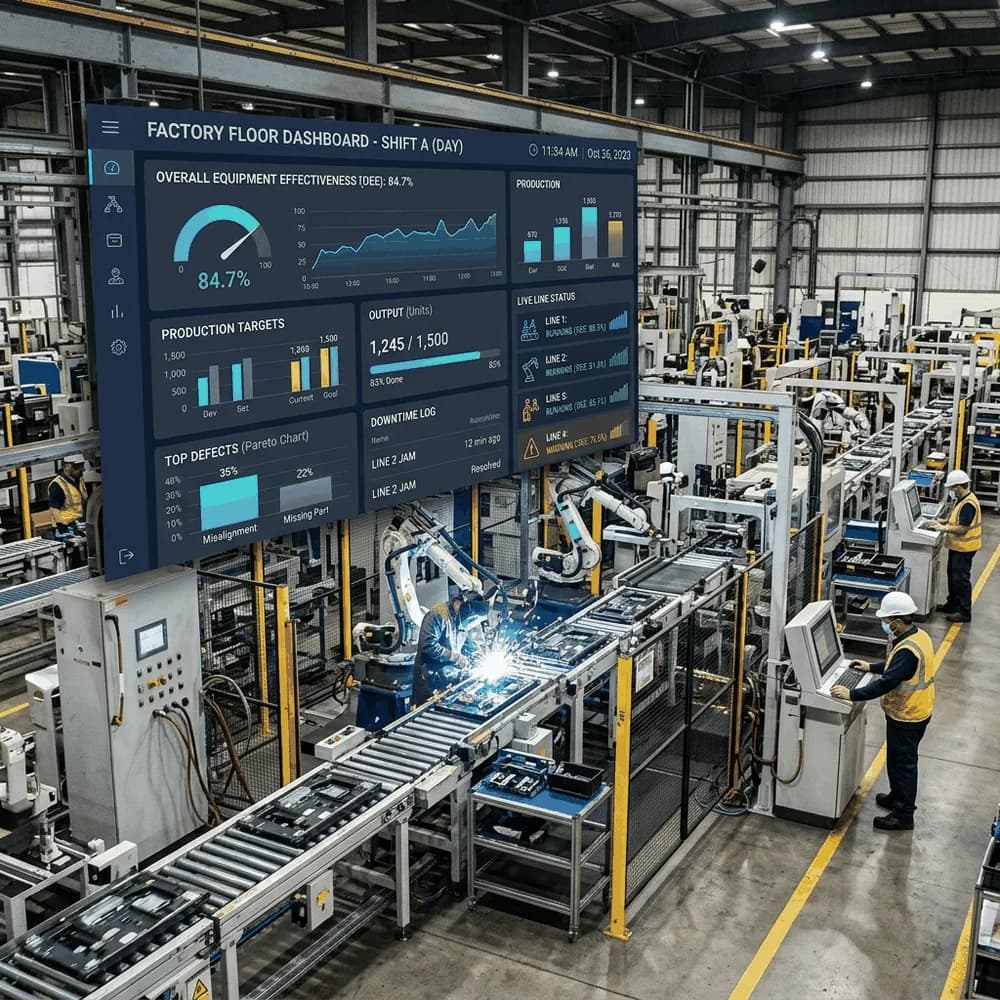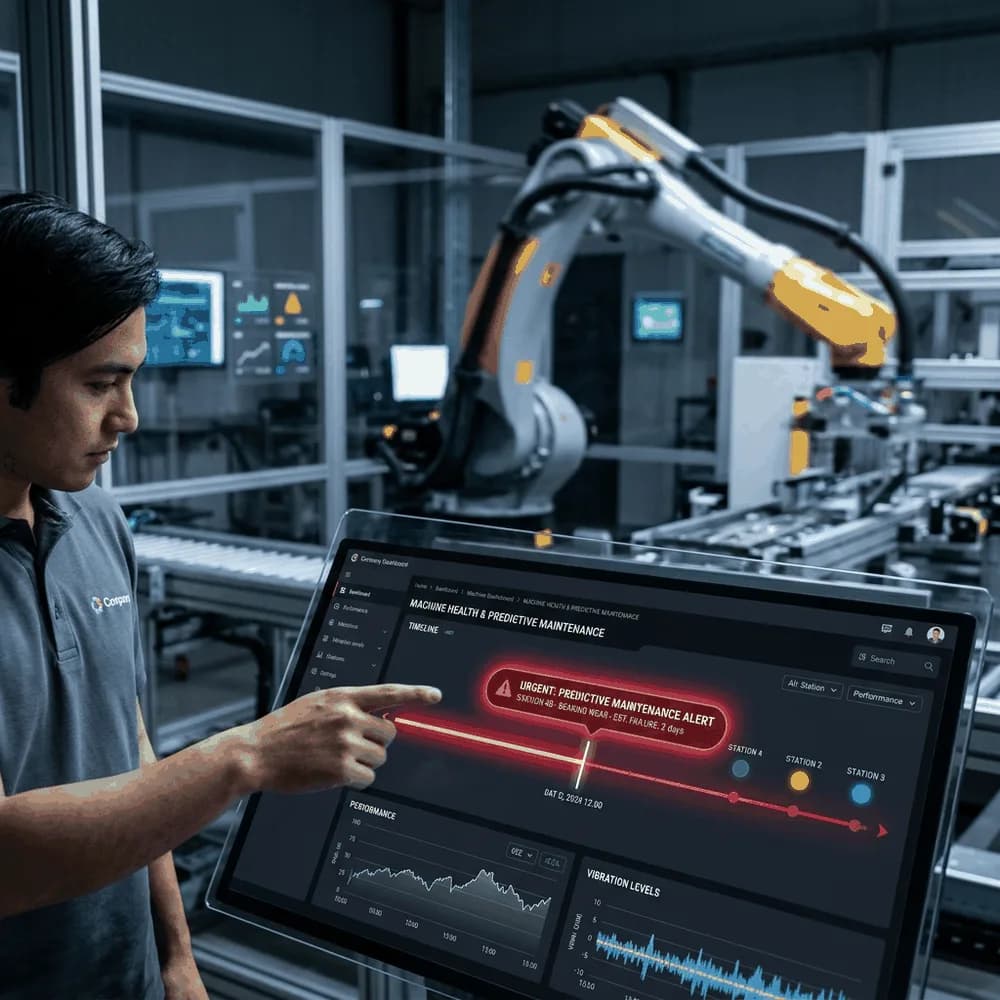








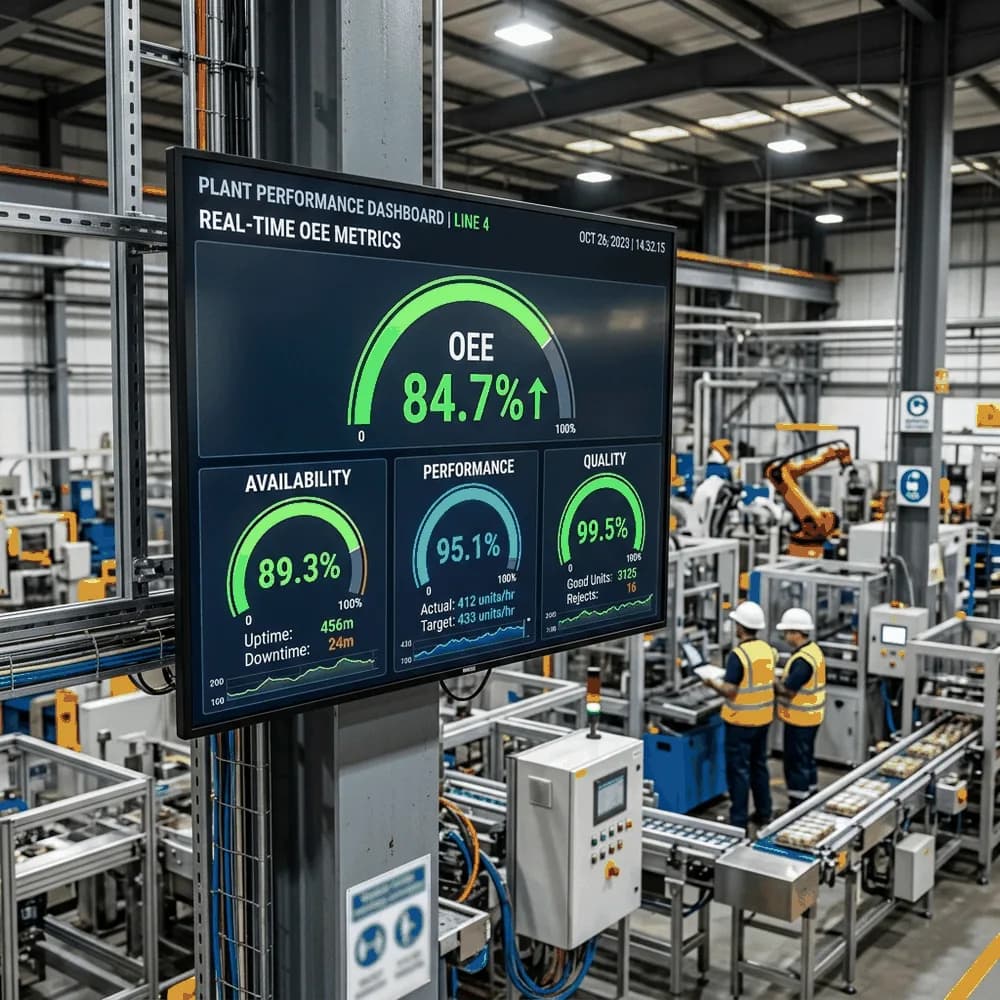
Overall Equipment Effectiveness (OEE) is the gold standard for measuring manufacturing productivity. Simply put, it identifies the percentage of manufacturing time that is truly productive. An OEE score of 100% means you are manufacturing only good parts, as fast as possible, with no stop time.
The OEE Formula
OEE is calculated by multiplying three factors:
OEE = Availability × Performance × Quality
- Availability takes into account all events that stop planned production long enough where it makes sense to track a reason (typically several minutes).
Formula: Run Time / Planned Production Time - Performance takes into account anything that causes the manufacturing process to run at less than the maximum possible speed when it is running.
Formula: (Total Count / Run Time) / Ideal Run Rate - Quality takes into account manufactured parts that do not meet quality standards, including parts that need rework.
Formula: Good Count / Total Count
The Six Big Losses
OEE is powerful because it breaks down total factory losses into six specific categories, allowing you to target exactly what is dragging down your productivity:
- Equipment Failure (Availability Loss): Breakdowns, tooling failures, or unplanned maintenance.
- Setup and Adjustments (Availability Loss): Changeovers, material shortages, or warmup time.
- Idling and Minor Stops (Performance Loss): Jams, misfeeds, or sensor blocks. These are often less than 5 minutes and are rarely tracked manually.
- Reduced Speed (Performance Loss): Operator inefficiency, equipment wear, or running a machine slower than its nameplate capacity to prevent jams.
- Process Defects (Quality Loss): Scrap, incorrect assembly, or parts damaged during production.
- Reduced Yield (Quality Loss): Defects produced during warmup, changeover, or before the process has reached a stable state.
Why Your Current OEE Is Probably Wrong
If your factory relies on operators filling out paper sheets at the end of a shift to calculate OEE, your resulting score is almost certainly inflated.
Why? Because human beings do not record 3-minute minor stops. If a machine jams, the operator clears it and restarts. They don't walk over to a clipboard, check the clock, and write down a 3-minute delay. But if that happens 15 times a shift, you have lost nearly an hour of production (Performance Loss) that simply looks like the machine was running slowly.
Furthermore, operators naturally want their shift to look good, so setup times are often underestimated.
The Solution: Automated Data Collection
To get true OEE, you must remove the human element from data collection. By connecting an MES or IIoT devices directly to the machine PLCs, the software records exactly when the machine starts and stops, counting every single cycle.
When companies switch from paper-based OEE to automated OEE, their score typically drops by 10 to 15 points overnight. The factory didn't get worse; the data just finally became accurate, revealing the "hidden factory" of minor stops and speed losses that management can now actually fix.